

Age verification has quietly become one of the biggest liability issues facing bars, restaurants, and retailers that sell alcohol and tobacco. For decades, confirming a customer’s age meant a quick glance at a driver’s license and a judgment call made under pressure during a busy shift. That approach carries real risk. Underage youth drank 8.6% of all alcohol sold in the US in 2016 alone, generating an estimated $17.5 billion in sales tied to underage consumption, and studies show underage buyers can still purchase alcohol without being asked for ID at least half the time in some testing.
Every US state requires alcohol sellers to confirm a buyer is 21 or older, and federal law sets the same threshold for tobacco, yet enforcement checks happen inconsistently across the country, leaving most of the compliance burden on individual businesses rather than regulators. This article walks through what age verification actually means for alcohol and tobacco sales, which products require it, and how manual ID checks stack up against automated POS-integrated scanning that reads a license, confirms the exact age, and flags fake or altered IDs automatically.
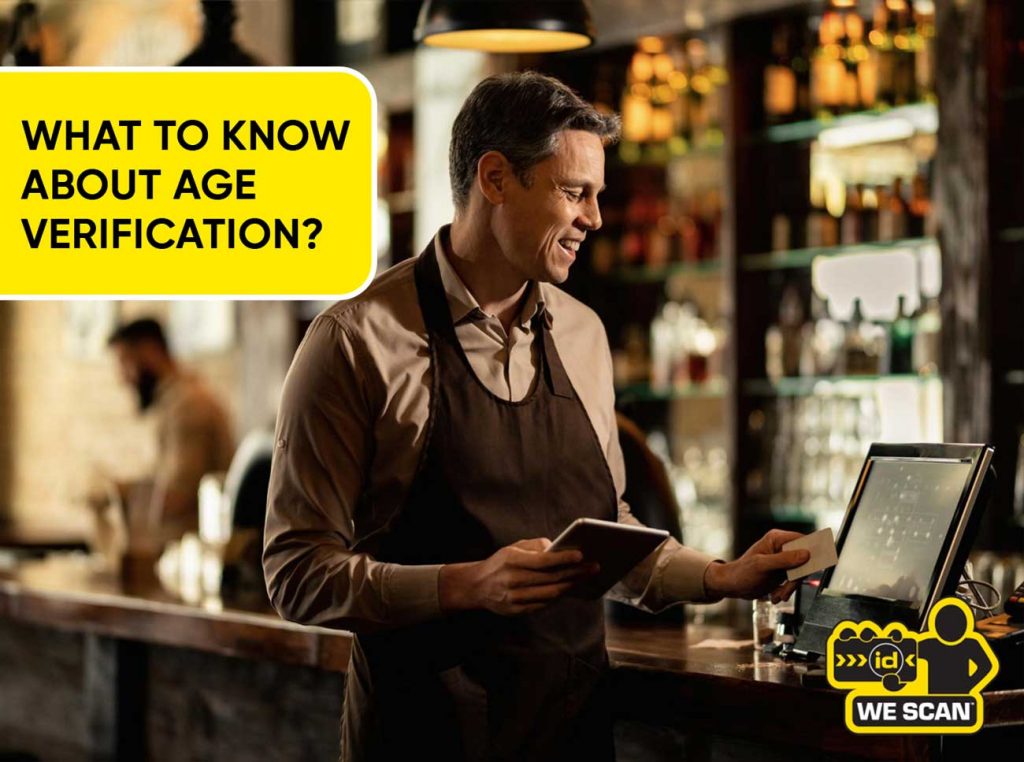
It also covers which documents are accepted, why dram shop liability makes this more than a simple compliance box to check, and which industries face the highest exposure, from bars and nightclubs to private clubs and convenience stores. Along the way, we look at the real operational challenges businesses run into, like staff inconsistency and high-pressure shifts, and close with practical best practices for building age verification directly into your point-of-sale system rather than leaving it to memory and judgment.
What is Age Verification?
Age verification is the process of confirming that a customer meets the legal age requirement before a business sells or serves an age-restricted product. In the alcohol and tobacco world, that means confirming a customer is 21 or older before a bartender pours a drink, a cashier rings up a six-pack, or a server delivers a bottle of wine to a table.
A business confirms a customer’s age against a government-issued ID. A cashier or server checks that ID at the point of sale. A compliance system records that the check happened, creating a defensible paper trail if the sale is ever questioned.
Traditionally, this check relied entirely on an employee’s judgment: reading a birthdate, checking a photo, sometimes doing quick math under pressure during a busy shift. That’s exactly where things go wrong, and exactly why ID scanning technology has become standard equipment at the point of sale rather than an optional extra.
What is the Difference Between Age Verification and Age Assurance?
In the retail and hospitality world, this distinction plays out mostly as manual versus automated verification. Manual verification is a staff member looking at an ID and deciding, on the spot, whether a customer is old enough. It’s fast, but it’s subjective, and it leaves no record beyond a decision made in a bartender’s head.
Automated verification, using an ID scanner integrated into a POS system, reads the barcode or magnetic stripe on a driver’s license, calculates the exact age from the encoded date of birth, flags fake or altered IDs, and logs the transaction. This removes the guesswork entirely. Instead of a server estimating whether someone “looks old enough,” the scanner returns a clear pass or fail based on the ID’s actual data, and the business gets a timestamped record of the check.
For high-liability sales like alcohol, that shift from subjective judgment to a documented system is the single biggest change age verification technology has brought to the industry.
Why is Age Verification Important?
Age verification protects businesses from serious financial and legal exposure, not just an abstract compliance box to check. The scale of underage access to alcohol and tobacco is well documented:
-
Underage alcohol consumption is significant
Underage youth drank 8.6% of all alcoholic drinks sold in the US market in 2016, according to peer-reviewed research, generating an estimated $17.5 billion in sales revenue tied to underage consumption that year.
-
The gap between law and practice is real
Studies using underage-looking buyers found they were able to purchase alcohol without being asked for ID at least half the time in some testing. That gap between what the law requires and what actually happens at the counter is exactly where a business’s liability lives.
-
Enforcement checks work, but only when they happen
Research reviewing multiple high-quality compliance-check studies found that active enforcement checks reduced underage sales by an average of 42%, showing how much impact consistent verification can have.
-
Tobacco compliance swings widely by location
Compliance research tracking ID checks by retailers has found significant swings depending on enforcement activity and local policy, with some studies showing violation rates for selling to underage buyers ranging from under 2% to nearly 30% depending on the state and year measured.
-
Staff judgment alone isn’t reliable.
Businesses that rely purely on staff judgment see meaningfully worse compliance outcomes than those with a system enforcing the check automatically.
Why Should Businesses Verify Age?
Bars, restaurants, private clubs, and retailers verify age for three overlapping reasons:
- Legal compliance
Prevents license suspension, fines, and criminal citations tied to selling alcohol or tobacco to a minor.
- Liability protection
Matters even more once alcohol is involved, since most states impose dram shop liability, meaning a business can be sued for damages caused by a customer it overserved or served underage, sometimes well beyond the incident itself.
- Operational consistency
Every employee, on every shift, applies the same standard rather than relying on individual judgment that can vary by person, by day, or by how busy the shift is.
Penalties for noncompliance can be severe and vary significantly by state:
- Immediate fines
A single underage sale can trigger a fine on its own.
- License review
Beyond the fine, a single underage sale can prompt a liquor license review.
- Dram shop lawsuits
A lawsuit tied to an overserved or underage customer can result in damages far exceeding the cost of any compliance system.
That asymmetry, a small operational investment against a potentially business-ending lawsuit, is exactly why more operators are automating this step rather than leaving it to memory and judgment.
Is Age Verification Legally Required?

Yes. Every US state requires alcohol retailers to verify that a buyer is at least 21 years old, and federal law sets the same minimum age nationwide for tobacco sales.
US Age Verification Laws for Alcohol and Tobacco
Alcohol and tobacco sales are each governed by their own set of legal age requirements in the US, and both rely heavily on businesses to enforce them at the point of sale. Here’s how the rules break down, and why enforcement gaps have pushed more operators toward automated checks.
-
Alcohol verification is required nationwide
Alcohol age verification is required in all 50 states, and vendors are legally obligated to confirm a buyer is 21 or older before completing a sale.
-
Enforcement happens through compliance checks
States enforce this primarily through compliance checks, where law enforcement or state alcohol beverage control agencies send an underage-looking buyer into a licensed business to attempt a purchase.
-
Enforcement is inconsistent across agencies
National survey data found that only about a third of local law enforcement agencies and roughly two-thirds of state agencies reported conducting these checks regularly, and among agencies that did conduct them, fewer than 10% checked every licensed establishment more than a few times a year.
-
This inconsistency drives automation
That inconsistency in enforcement is exactly why many businesses choose not to rely on the odds of getting caught and instead build verification into every transaction automatically.
-
Tobacco sales fall under federal Tobacco 21 law
This law raised the legal purchase age to 21 nationwide and directs retailers to check ID for any customer who appears to be under 27.
-
The FDA inspects tobacco retailers for compliance
Violation rates have varied considerably by state and by year, underscoring how enforcement intensity and technology adoption directly affect outcomes.
-
Private clubs face an added layer of regulation
Clubs operating in dry or partially dry jurisdictions must often verify not just age but active membership status before serving alcohol, along with detailed recordkeeping to demonstrate compliance during regulatory review.
What are Age Restricted Products?
Age restricted products are goods that a business cannot legally sell to a customer under a defined minimum age, regardless of the sale channel or setting. In the alcohol and tobacco trade specifically, this typically includes:
- Beer, wine, and spirits, requiring buyers to be 21, verified at the bar, table, or register
- Tobacco and vaping products, requiring buyers to be 21 under federal law, with ID checks expected for anyone appearing under 27
- Cannabis, in states where recreational or medical sales are legal, requiring verification at 18 or 21 depending on the state
- Lottery tickets and gambling products, in states where convenience stores and similar retailers sell them, typically requiring buyers to be 18 or 21
How Does Age Verification Work at the Point of Sale?
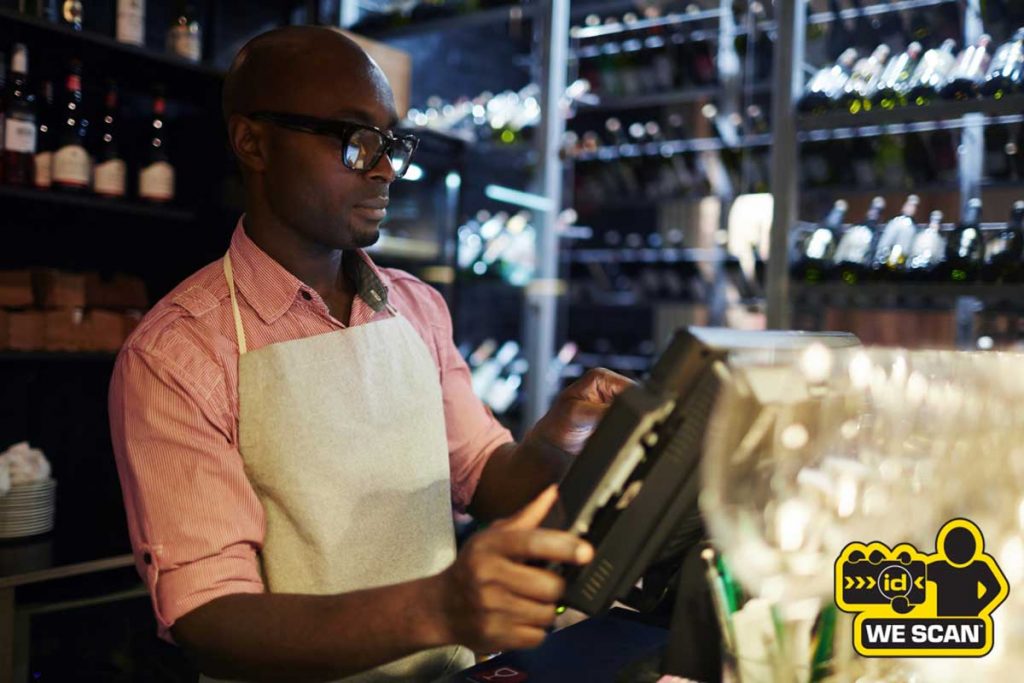
At the counter or bar, age verification typically follows a consistent flow: a customer presents an ID, the ID is checked against a legal age threshold, and the sale either proceeds or is declined based on that result. The difference between businesses is how that middle step happens, whether it’s a quick visual glance or an automated scan integrated directly into the point-of-sale system.
What Are Age Verification Methods?
Age verification methods generally fall into two categories: manual checks that rely on staff judgment, and technology-driven checks that automate the process. Below is a look at how each approach works in practice.
-
Manual ID check:
A staff member visually inspects a driver’s license or state ID and calculates age from the birthdate. Fast, but entirely dependent on individual judgment and attentiveness.
-
POS-integrated ID scanning:
A scanner reads the barcode or magnetic stripe encoded on a government ID, instantly confirms the exact age, and can block a sale automatically if the customer doesn’t meet the threshold. This is now standard equipment at many bars, restaurants, and liquor stores, and integrates directly with POS platforms like Toast and Aloha.
-
Handheld and mobile scanning:
Servers and bartenders use handheld devices or POS-connected mobile hardware to scan IDs tableside or at a bar top, rather than requiring customers to come to a fixed terminal.
-
Fake ID detection:
Scanning technology cross-checks the encoded data against the ID’s format and can flag inconsistencies that suggest a fake or altered document, something a quick visual check often misses, especially during a busy shift.
Manual checks remain common, but they carry a real accuracy problem. Visual age checks depend on staff correctly reading a birthdate under time pressure and correctly judging borderline cases, which is exactly the kind of subjective decision that leads to inconsistent enforcement across shifts, locations, and staff turnover.
What Documents Are Accepted for Age Verification?
Businesses selling alcohol and tobacco generally accept:
- Driver’s licenses and state-issued ID cards
- Passports and passport cards
- Military ID cards
- In some states, tribal ID cards
Modern ID scanners are built to read the standardized barcode formats used across all 50 states plus US territories, which matters for businesses near state lines or in areas with significant out-of-state customer traffic.
Can Age Verification Be Done Without Collecting Personal Data?
For in-person alcohol and tobacco sales, businesses generally don’t need to store personal data at all to meet their legal obligation, they only need to confirm the age threshold was met at the time of sale. Modern POS-integrated scanning systems are built around exactly that principle: the scanner reads the ID, confirms the age, and logs that a check occurred, without necessarily retaining the customer’s name, address, or ID number in a way that creates unnecessary data liability for the business.
This matters operationally as much as legally. A system that just proves “this customer’s ID confirmed they were 21 or older at 9:47 PM” gives a business everything it needs for compliance and defense in a dram shop claim, without the business taking on the burden and risk of storing sensitive personal documents indefinitely.
Is Age Verification Safe?
For alcohol and tobacco retailers, the safety conversation is less about data breaches and more about operational reliability and legal defensibility. The core risk businesses face isn’t a hacked database, it’s an undocumented sale that later becomes a lawsuit or a license violation with no record showing what happened.
That’s why compliance-focused verification systems emphasize creating a real-time, auditable record every time a check occurs. If a business is ever investigated after an incident, whether that’s a compliance sting or a dram shop claim following an overserved customer, having a system-generated log showing exactly when an ID was checked and what the result was is far stronger evidence than an employee’s recollection of what happened during a busy Friday night shift.
What Industries Use Age Verification?

Age verification touches nearly every part of the on-premise and off-premise alcohol and tobacco trade:
- Bars and nightclubs, where fast-paced service and high customer volume make consistent manual checks especially difficult
- Restaurants, where servers must verify age table-side, often while juggling multiple other responsibilities
- Private clubs, which face additional regulatory requirements around membership verification in many dry and partially dry jurisdictions
- Liquor stores, where every transaction potentially involves an age-restricted sale
- Convenience stores and gas stations, which sell both alcohol and tobacco and face compliance checks for both categories
- Bowling alleys, entertainment venues, and hospitality groups, which serve alcohol as part of a broader guest experience and need policy enforcement across multiple locations and concepts
What Are the Challenges of Age Verification?
The challenges of age verification are listed below:
-
Staff inconsistency:
Different employees apply different levels of scrutiny, and turnover means training has to happen constantly rather than once.
-
High-pressure environments:
Bars and busy restaurants create exactly the conditions, speed, crowds, distraction, where a quick visual ID check is most likely to be rushed or skipped.
-
Fake and altered IDs:
Visual inspection alone often can’t catch a well-made fake, especially under dim bar lighting or during a rush.
-
Multi-location consistency:
Businesses with several locations or franchise concepts need the same policy enforced everywhere, not just at flagship locations with more attentive management.
-
Recordkeeping for legal defense:
Without a system-generated log, a business has little to point to after an incident beyond an employee’s memory of what happened.
-
Dram shop liability:
Even a single overserved or underage sale can expose a business to liability well beyond the value of the transaction itself.
Best Practices for Age Verification for Businesses
The best practices for age verification for businesses are listed below:
-
Automate the check at the point of sale
Integrating ID scanning directly into your POS system, rather than relying on a standalone process, removes the subjective judgment call from busy staff and applies the same standard every time.
-
Standardize policy across every location
Centralized policy configuration lets an operator apply consistent rules by region, concept, or individual location, rather than trusting each site to interpret guidance independently.
-
Build a real-time compliance record
A system that logs every ID check gives a business a defensible paper trail if a sale is ever questioned by a regulator, an insurer, or a court.
-
Train staff around the system, not instead of it
Technology reinforces training rather than replacing it. Staff still need to understand policy, but the system removes the ambiguity in borderline cases.
-
Watch for overserving, not just underage sales
Responsible service programs increasingly monitor consumption patterns as well as age, since overserving liability is often just as significant as underage sales liability under dram shop laws.
-
Choose hardware that fits how your business actually operates
Fixed terminals work for liquor stores and registers, but bars and full-service restaurants often need handheld or mobile scanning that goes to the table or the bar top rather than requiring the customer to come to a counter.
-
Integrate with the POS systems you already use
A verification system that plugs directly into platforms like Toast or Aloha, rather than running as a separate disconnected process, is far more likely to actually get used consistently by staff.
Age verification for alcohol and tobacco sales is no longer a matter of trusting staff judgment. Between dram shop exposure, license risk, and inconsistent state enforcement, the businesses that come out ahead are the ones that treat every ID check as a documented, repeatable process, not a one-off decision made at the counter.